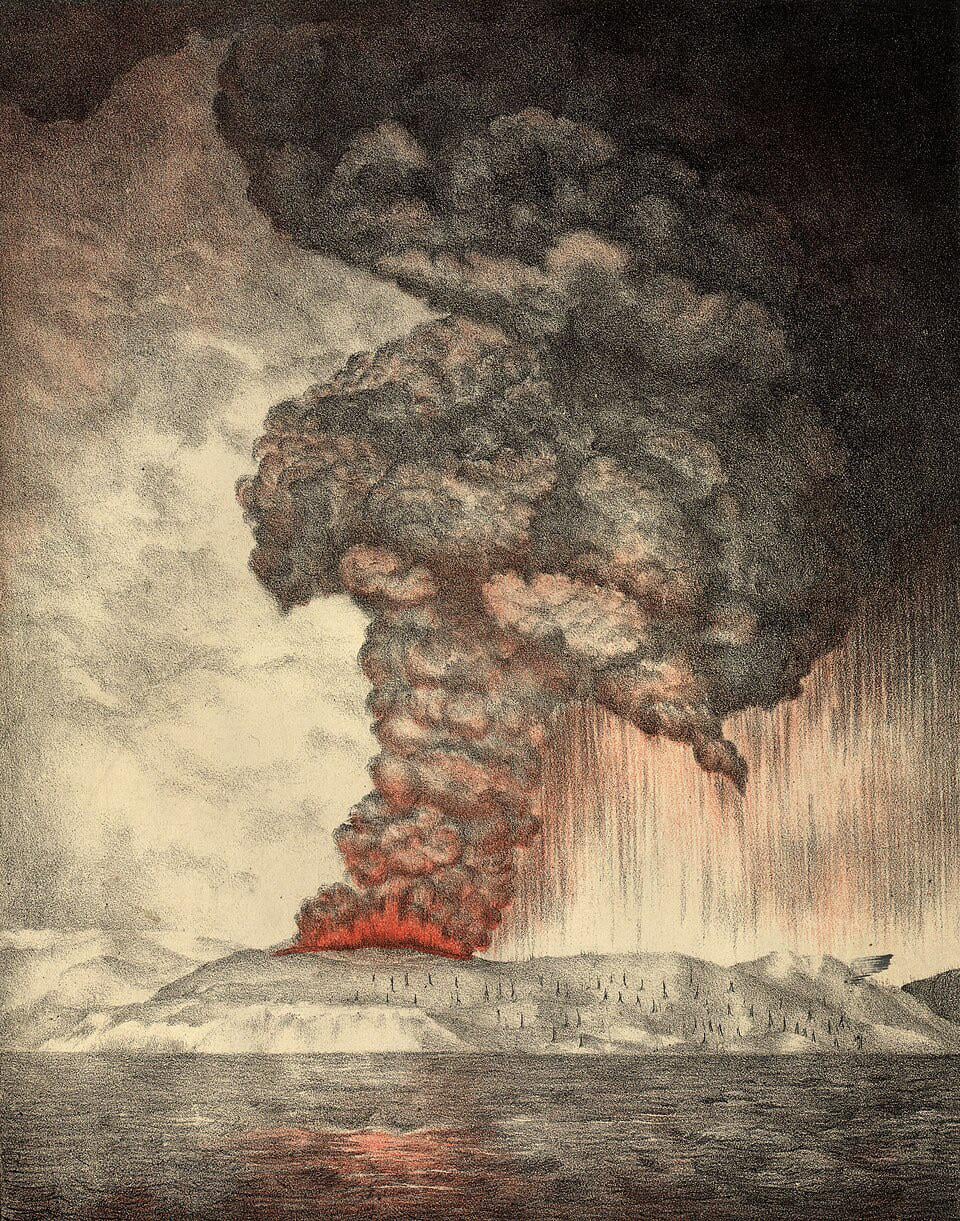
On August 27, 1883, at 10:02 in the morning, the Krakatoa volcano erupted with such devastating force that it produced the loudest sound ever recorded in human history, around 310 decibels.
For comparison, a jet engine produces about 140 dB, and a nearby nuclear explosion reaches roughly 210 to 220 dB. Krakatoa completely obliterated everything. The explosion was equivalent to about 200 megatons of TNT, roughly 13,000 times more powerful than the Hiroshima bomb.
The sound was heard 4,800 kilometers away. People on Rodrigues Island in the Indian Ocean, nearly 5,000 kilometers away, clearly heard the blast. In Perth, Australia, about 2,000 kilometers away, the sound arrived only 4 hours later. Sailors just 60 km away had their eardrums literally ruptured by the shockwave.
The pressure wave was so powerful that it circled the planet seven times and was detected by sensitive barometers in London and New York. The entire Earth essentially rang from the explosion.
When the island collapsed, it triggered tsunamis up to 46 meters high, comparable to 15 story buildings made of water moving at full speed. A warship called Berouw was thrown 3 kilometers inland into the jungle, where its wreck remained for decades as proof of the raw force of nature.
36,417 people died, most of them not from lava but from the massive tsunamis that wiped out 165 entire coastal villages. The destruction was so extreme that more than 70 percent of the island disappeared, collapsing into a volcanic caldera.
The global effects were just as dramatic. The explosion blasted about 20 million tons of sulfur into the stratosphere, creating what scientists call a volcanic winter that cooled global temperatures by roughly 0.4°C to 1.3°C. For three consecutive years the world experienced unusually vivid red and purple sunsets. Some historians even speculate that these skies inspired Edvard Munch’s famous painting The Scream from 1893.
One of the most shocking accounts comes from Captain Sampson of the ship Norham Castle, which was about 40 kilometers away. He wrote: “The explosions are so violent that the eardrums of more than half my crew have been destroyed. I am convinced the Day of Judgment has come.”
The volcano did not disappear forever. In 1927 a new volcano called Anak Krakatau, meaning Child of Krakatoa, emerged in the same spot and it remains active today. In 2018 a smaller eruption triggered a tsunami that killed 429 people, reminding the world that the area is still extremely dangerous.
The 1883 Krakatoa eruption remains one of the most astonishing natural events ever recorded, not just because of the sheer scale of the sound, but because of its global impact, the unmatched destruction, and the reminder that we live on a planet that ultimately belongs to nature.
redditknees on
Is that the origin of the saying “a loud crack!”
Sonicxmusic on

ranting_chef on
If it’s recorded, is it possible to hear the recording?
st0pmakings3ns3 on
if I were to go to any place in any time, it would be this event, from whatever a safe distance would be.
hrdlg1234 on
Interesting how did they determine the amount of decibels the eruption made to classify it as the loudest sound ever since the decibel system was 40 years after the eruption occured
So we just need 4-5 Krakatoas going off around the world to cool things down for a bit. Global warming solved ezpz Nobel Peace prize pls.
CaliforniaLove11 on
I heard Seinfeld donated some money to Kramer for the Krakatoan people.
Funny_Baseball_2431 on
I was there for it!
joelupi on
So I can conceptually understand what this is saying. But I think I am trying to figure out what actually happened.
Was it this crack/boom/roar that just traveled over the entire earth? Over plains and mountains and cities.
Wouldn’t it have caused people to absolutely lose it? Especially if it went back around the earth again and again.
yungandreww on
the Krakatoa Explosion in 1883 was the loudest ever recorded sound wave on Earth at 180 decibels 100 miles away (the shock wave is 310db near the volcano itself). the explosion was heard more than 3,000 miles away.
though technically it’s a shock wave and not a sound wave. because sound doesn’t exist higher than 194db at sea level. At 194 db, sound waves starts distorting and they create a complete vacuum between themselves. the excess are turned into shock waves. a 300db shock wave would definitely kill a human, though I am not sure if it will actually disintegrate him. 300db is the equivalent of 1e^(27) watts
unsightly_buildup on
My wife has a crazy loud voice. CRAZY LOUD!
toxic_egg on
13,000 x more power than the Hiroshima bomb. Yoiks
nndel on
Krakatoa’s eruption is estimated at 310 decibels, Tsar Bomba at about 224 from actual instruments, and the beer fart I had last night was silent but arguably just as deadly as both.
Ksorkrax on
Yeah, I read about that in very informative study material.
You ain’t heard nuthin yet-just wait until the Yellowstone caldera blows- it will make Krakatoa seem like a kid popping a pimple
pendletonskyforce on
How was it recorded?
marvelnerd09 on
audio proof or it didn’t happen
TheLostMaverick on
I don’t know man, I slept in a hotel room with my dad recently and the snoring was off the charts!
ThrifToWin on
Who recorded it?
Otaraka on
For those who might not know, each 10 decibels is double the sound as its logarithmic.
So going from 210 for a nuclear explosion to 310 is 1024 times louder.
Ouch.
Number174631503 on

WhatTheHosenHey on
East of Java.
EyyYoMikey on
Makes me wonder how many decibels they suspect the explosive eruption of Thera back in the bronze age was. That eruption is suspected of being even larger than Krakatoa.

25 Comments
On August 27, 1883, at 10:02 in the morning, the Krakatoa volcano erupted with such devastating force that it produced the loudest sound ever recorded in human history, around 310 decibels.
For comparison, a jet engine produces about 140 dB, and a nearby nuclear explosion reaches roughly 210 to 220 dB. Krakatoa completely obliterated everything. The explosion was equivalent to about 200 megatons of TNT, roughly 13,000 times more powerful than the Hiroshima bomb.
The sound was heard 4,800 kilometers away. People on Rodrigues Island in the Indian Ocean, nearly 5,000 kilometers away, clearly heard the blast. In Perth, Australia, about 2,000 kilometers away, the sound arrived only 4 hours later. Sailors just 60 km away had their eardrums literally ruptured by the shockwave.
The pressure wave was so powerful that it circled the planet seven times and was detected by sensitive barometers in London and New York. The entire Earth essentially rang from the explosion.
When the island collapsed, it triggered tsunamis up to 46 meters high, comparable to 15 story buildings made of water moving at full speed. A warship called Berouw was thrown 3 kilometers inland into the jungle, where its wreck remained for decades as proof of the raw force of nature.
36,417 people died, most of them not from lava but from the massive tsunamis that wiped out 165 entire coastal villages. The destruction was so extreme that more than 70 percent of the island disappeared, collapsing into a volcanic caldera.
The global effects were just as dramatic. The explosion blasted about 20 million tons of sulfur into the stratosphere, creating what scientists call a volcanic winter that cooled global temperatures by roughly 0.4°C to 1.3°C. For three consecutive years the world experienced unusually vivid red and purple sunsets. Some historians even speculate that these skies inspired Edvard Munch’s famous painting The Scream from 1893.
One of the most shocking accounts comes from Captain Sampson of the ship Norham Castle, which was about 40 kilometers away. He wrote: “The explosions are so violent that the eardrums of more than half my crew have been destroyed. I am convinced the Day of Judgment has come.”
The volcano did not disappear forever. In 1927 a new volcano called Anak Krakatau, meaning Child of Krakatoa, emerged in the same spot and it remains active today. In 2018 a smaller eruption triggered a tsunami that killed 429 people, reminding the world that the area is still extremely dangerous.
The 1883 Krakatoa eruption remains one of the most astonishing natural events ever recorded, not just because of the sheer scale of the sound, but because of its global impact, the unmatched destruction, and the reminder that we live on a planet that ultimately belongs to nature.
Is that the origin of the saying “a loud crack!”

If it’s recorded, is it possible to hear the recording?
if I were to go to any place in any time, it would be this event, from whatever a safe distance would be.
Interesting how did they determine the amount of decibels the eruption made to classify it as the loudest sound ever since the decibel system was 40 years after the eruption occured
[I’m assuming this?](https://youtu.be/v2pPRiUUnOg?si=htiwNcHSLH5fPAwQ)
That’s pretty wild if so holy shit
So we just need 4-5 Krakatoas going off around the world to cool things down for a bit. Global warming solved ezpz Nobel Peace prize pls.
I heard Seinfeld donated some money to Kramer for the Krakatoan people.
I was there for it!
So I can conceptually understand what this is saying. But I think I am trying to figure out what actually happened.
Was it this crack/boom/roar that just traveled over the entire earth? Over plains and mountains and cities.
Wouldn’t it have caused people to absolutely lose it? Especially if it went back around the earth again and again.
the Krakatoa Explosion in 1883 was the loudest ever recorded sound wave on Earth at 180 decibels 100 miles away (the shock wave is 310db near the volcano itself). the explosion was heard more than 3,000 miles away.
though technically it’s a shock wave and not a sound wave. because sound doesn’t exist higher than 194db at sea level. At 194 db, sound waves starts distorting and they create a complete vacuum between themselves. the excess are turned into shock waves. a 300db shock wave would definitely kill a human, though I am not sure if it will actually disintegrate him. 300db is the equivalent of 1e^(27) watts
My wife has a crazy loud voice. CRAZY LOUD!
13,000 x more power than the Hiroshima bomb. Yoiks
Krakatoa’s eruption is estimated at 310 decibels, Tsar Bomba at about 224 from actual instruments, and the beer fart I had last night was silent but arguably just as deadly as both.
Yeah, I read about that in very informative study material.
https://preview.redd.it/l809lkh6qnqg1.jpeg?width=493&format=pjpg&auto=webp&s=ba9b06797ef3cb1e03429892c84ffd1a6c6a91c5
You ain’t heard nuthin yet-just wait until the Yellowstone caldera blows- it will make Krakatoa seem like a kid popping a pimple
How was it recorded?
audio proof or it didn’t happen
I don’t know man, I slept in a hotel room with my dad recently and the snoring was off the charts!
Who recorded it?
For those who might not know, each 10 decibels is double the sound as its logarithmic.
So going from 210 for a nuclear explosion to 310 is 1024 times louder.
Ouch.

East of Java.
Makes me wonder how many decibels they suspect the explosive eruption of Thera back in the bronze age was. That eruption is suspected of being even larger than Krakatoa.